
Check Valves
- Home
- / Products
- / Valves
- / Check Valves
KSF Valves Pvt. Ltd.
Check Valves
Check valves, also known as non-return valves, are automatic valves designed to allow fluid to flow in only one direction while preventing reverse flow. They operate solely by the pressure and flow of the fluid, without any external control. When the fluid moves in the correct direction, the valve opens; when flow reverses, it closes automatically to stop backflow and protect pumps, compressors, and pipelines from damage.
When fluid flows in the desired direction, the pressure pushes the valve open, allowing smooth passage. If the flow reverses, the valve closes automatically—usually by gravity, spring force, or back pressure—stopping any return of the fluid. This helps protect pumps, compressors, and other equipment from damage caused by reverse flow, such as water hammer, pressure surges, or contamination of clean media with unwanted substances.
There are four main types of Check Valves :
- Dual Plate Check Valves
- Forged Steel Check Valves
- Pressure Sealed Check Valves
- Swing Check Valves
- Swing Flex Check Valves

Applications:
Check valves are used in various industries and applications, including water and wastewater treatment, oil and gas, chemical processing, power generation, HVAC (heating, ventilation, and air conditioning), firefighting systems, and many others.
Maintenance:
Regular inspection and cleaning are essential to keep check valves working efficiently. Check for wear, corrosion, or debris that may affect sealing or movement. Ensure the valve opens and closes smoothly, and replace worn parts like discs, springs, or seals if needed. Proper installation and periodic testing help extend the valve’s service life and maintain reliable performance.
Advantages:
• The primary function of check valves is to prevent reverse flow of fluids or gases in pipelines.
• By preventing backflow, check valves help maintain the efficiency of fluid handling systems.
• Check valves protect pumps, compressors, and other equipment from damage that can occur when fluids flow back into them.
• Check valves are available in various types, sizes, and materials to suit a wide range of applications and operating conditions.
• Check valves play a crucial role in ensuring the safety of fluid handling systems, particularly in applications involving hazardous or toxic fluids.
Specifications
| Testing Standards: | BS 5146 |
|---|---|
| Size Ranges: | 2″-16″ (DN50-DN400) |
| Class: | 150-2500 |
| Material of Construction: | WCB, WCC, WC6, WC9, C5, C12, LCB,LCC, CF8, CF8M, etc. |
| Seat: | A105+13%Cr, A105+Steelited. |
| Trim: | API No 1 to 16. |
| Face to Face: | As per ASME B16.10 |
| Actuation: | Manual, Gear, etc. |
| End Connection: | ANSI B16.5(Raised Flanged), ANSI B16.25(Butt Weld) |

KSF Valves Pvt. Ltd.
Dual Plate Check Valves
dual plate check valves are compact, lightweight valves designed to prevent backflow in pipelines. They feature two spring-loaded plates that open with forward flow and close quickly when flow reverses, minimizing water hammer and pressure surges. Built for durability and efficiency, dual plate check valves are ideal for water, oil, gas, and industrial process applications where space-saving design and reliable performance are essential.
Design and Construction:
• Dual plate check valves consist of two semicircular plates or discs that are mounted on a hinge pin within a single body. The plates are designed to open in response to forward flow, allowing fluid to pass through the valve.
• When flow stops or reverses, the plates close under the influence of gravity and flow pressure, preventing backflow.
• The hinge pin allows the plates to swing freely, providing low-pressure drop and efficient operation.
Materials of Construction:
• Dual plate check valves are available in a variety of materials to suit different application requirements, including carbon steel, stainless steel, ductile iron, bronze, and exotic alloys.
• The choice of materials depends on factors such as the fluid being handled, temperature, pressure, and corrosion resistance requirements.
Standards and Certifications:
• Dual plate check valves are manufactured according to industry standards and specifications such as API (American Petroleum Institute), ASME (American Society of Mechanical Engineers), ASTM (American Society for Testing and Materials), ANSI (American National Standards Institute), and others.
• They may also meet specific regulatory requirements or certifications for use in critical applications or hazardous environments.
KSF Valves Pvt. Ltd.
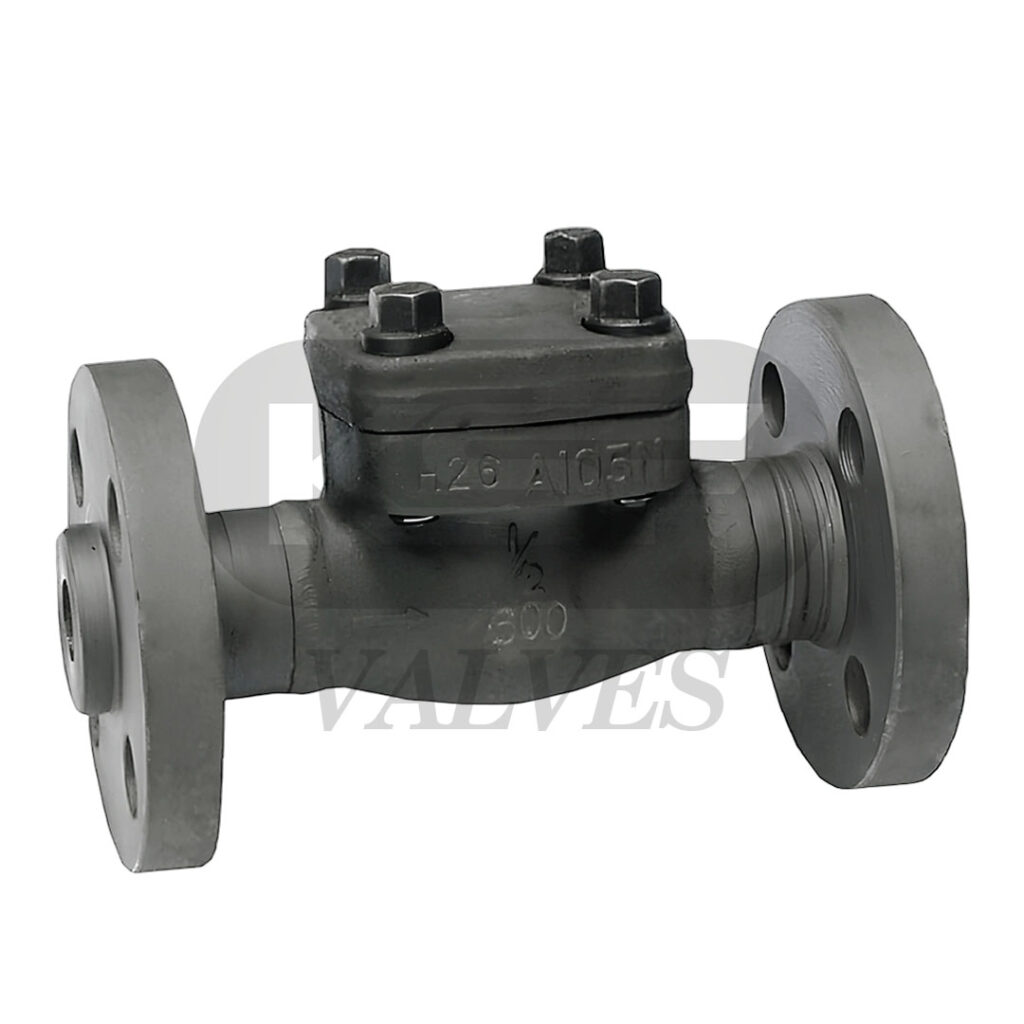
Forged Steel Check Valves
Forged steel check valves are strong, durable valves that allow flow in one direction and prevent backflow. Built for high-pressure and high-temperature applications, they offer excellent sealing and corrosion resistance. Commonly used in steam lines, process industries, and hydraulic systems.
Design and Construction:
• Forged steel check valves are available in various designs, including swing check valves and lift check valves. Swing check valves feature a hinged disc that swings open in the direction of flow and closes under the influence of gravity or reverse flow.
• Forged steel check valves are constructed using forged steel components for enhanced strength and durability.
• The main components typically include a body, bonnet, disc (or flap), seat, and hinge pin. The valve body and bonnet are forged from steel to withstand high pressures, while the disc is designed to open and close to allow or prevent flow.
• Lift check valves utilize a disc or piston that lifts from the seat to allow flow and settles back to close off flow when pressure decreases or reverses.
Materials of Construction:
• Forged steel check valves are typically made from materials such as carbon steel, stainless steel, or alloy steel.
• The choice of material depends on factors such as the fluid being handled, temperature, pressure, corrosion resistance requirements, and compatibility with other system components.
Standards and Certifications:
• Forged steel check valves are manufactured in accordance with industry standards and specifications such as API (American Petroleum Institute), ASME (American Society of Mechanical Engineers), ASTM (American Society for Testing and Materials), ANSI (American National Standards Institute), and others.
• They may also meet specific regulatory requirements or certifications for use in critical applications or hazardous environments.

KSF Valves Pvt. Ltd.
Pressure Sealed Check Valves
Pressure seal check valves are designed for high-pressure and high-temperature applications, ensuring one-way flow and preventing backflow. They feature a pressure seal bonnet that tightens as internal pressure increases, providing a reliable, leak-free seal. Compact and durable, these valves are ideal for steam, power generation, and other critical process systems requiring tight shutoff and long service life.
Design and Construction:
• Pressure sealed check valves are available in various designs, including swing check valves and lift check valves. Swing check valves feature a hinged disc that swings open in the direction of flow and closes under the influence of gravity or reverse flow.
• Lift check valves utilize a disc or piston that lifts from the seat to allow flow and settles back to close off flow when pressure decreases or reverses.
• Pressure sealed check valves are constructed with robust materials and a unique pressure seal bonnet design to withstand extreme operating conditions. The main components typically include a body, bonnet, disc (or flap), seat, and hinge pin.
• The body and bonnet are designed with pressure seal arrangements, such as threaded, welded, or bolted connections, to ensure a tight seal under high pressure. The disc is engineered to open and close smoothly to allow or prevent flow, while the seat provides a sealing surface for the disc.
Materials of Construction:
• Pressure sealed check valves are typically made from high-quality materials such as carbon steel, stainless steel, alloy steel, or other specialized alloys capable of withstanding high pressures and temperatures.
• The choice of material depends on factors such as the fluid being handled, temperature, pressure, corrosion resistance requirements, and compatibility with other system components.
Standards and Certifications:
• Pressure sealed check valves are manufactured in accordance with industry standards and specifications such as API (American Petroleum Institute), ASME (American Society of Mechanical Engineers), ASTM (American Society for Testing and Materials), ANSI (American National Standards Institute), and others.
• They may also meet specific regulatory requirements or certifications for use in critical applications or hazardous environments.

KSF Valves Pvt. Ltd.
Swing Check Valves
Swing check valves allow fluid to flow in one direction and prevent reverse flow using a hinged disc that swings open with forward flow and closes when flow reverses. Their simple design ensures low pressure drop and reliable operation. These valves are commonly used in water, wastewater, and process systems where minimal maintenance and smooth flow are essential.
Design and Construction:
• Swing check valves consist of a body with inlet and outlet ports, a hinged disc, and a hinge pin or shaft. The disc is attached to the hinge pin and swings freely within the body to allow or prevent flow.
• When forward flow occurs, the disc swings open, allowing fluid to pass through. When flow stops or reverses, the disc swings closed under the influence of gravity or reverse flow, preventing backflow.
Applications:
• Swing check valves are used in a wide range of industries and applications where backflow prevention is critical.
• They are commonly installed in pipelines, pump discharge lines, steam lines, and process equipment to prevent reverse flow and protect equipment and processes from damage.
Materials of Construction:
• Swing check valves are available in various materials to suit different application requirements, including carbon steel, stainless steel, bronze, cast iron, and exotic alloys.
• The choice of material depends on factors such as the fluid being handled, temperature, pressure, corrosion resistance requirements, and compatibility with other system components.

KSF Valves Pvt. Ltd.
Swing Flex Check Valves
Swing flex check valves are advanced versions of traditional swing check valves, designed to provide smooth, silent operation. They use a flexible disc that opens easily with forward flow and gently returns to the seat without slamming, reducing water hammer and vibration. Compact, durable, and low-maintenance, swing flex check valves are ideal for water, wastewater, and pumping applications where quiet and efficient flow control is required.
Design and Construction:
Swing flex check valves feature a unique flexible disc or flap design that allows for smooth operation and reduced wear compared to traditional swing check valves.
The flexibility of the disc also helps to minimize the effects of water hammer and slamming during operation.
The flexible disc is typically made of elastomeric materials such as rubber or synthetic polymers, providing a tight seal against the valve seat to prevent backflow.
Applications:
Swing flex check valves are commonly used in applications where reliable backflow prevention and efficient flow control are required.
They are suitable for use in pipelines, pump discharge lines, sewage systems, stormwater drainage systems, and other fluid handling applications.
Materials of Construction:
Swing flex check valves are available in a variety of materials to suit different application requirements, including cast iron, ductile iron, carbon steel, stainless steel, and various elastomeric materials for the disc.
The choice of material depends on factors such as the fluid being handled, temperature, pressure, corrosion resistance requirements, and compatibility with other system components.