
Ball Valves
- Home
- / Products
- / Valves
- / Ball Valves
KSF Valves Pvt. Ltd.
Ball Valves
The main work of a ball valve is to control the flow of fluid by opening, closing, or partially obstructing the passage through a rotating ball. It provides quick shutoff with a simple quarter-turn operation and ensures leak-tight sealing even under high pressure.
Ball valves are widely used in water supply systems, chemical processing, HVAC, food industries, and manufacturing plants for reliable on/off control and easy maintenance. They are preferred where fast operation and minimal pressure drop are required.
There are four main types of Ball Valves :
- Forged Ball Valves
- Floating Ball Valves
- Trunnion Ball Valves
- Lined Ball Valves

Applications:
Ball valves are widely used for reliable flow control and tight shutoff in water, wastewater, chemical, pharmaceutical, food, marine, and irrigation systems. They also serve in steam, air, and hydraulic lines for quick on/off operation. Their durability and leak-tight design make them ideal for both high- and low-pressure applications.
Maintenance:
Regularly inspect ball valves for leaks, corrosion, or wear. Clean internal parts to ensure smooth operation and tight sealing. Lubricate moving parts if needed and replace damaged seals or seats. Routine checks and proper use help extend valve life and maintain reliable performance.
Advantages:
• Quick on/off control with simple quarter-turn operation
• Provides tight sealing and leak-free performance
• Minimal pressure drop during operation
• Compact design and easy to install
• Low maintenance with long service life
• Reliable performance under high pressure and temperature
Specifications
| Testing Standards : | BS 5146 |
|---|---|
| Size Ranges : | 2″-16″ (DN50-DN400) |
| Class : | 150-2500 |
| Material of Construction: | WCB, WCC, WC6, WC9, C5, C12, LCB,LCC, CF8, CF8M, etc. |
| Face to Face: | As per ASME B16.10 |
| Actuation: | Manual, Gear, etc. |
| End Connection: | ANSI B16.5(Raised Flanged), ANSI B16.25(Butt Weld), ANSI 16.11(Socket Weld), ANSI B1.20.1(Screwed End) |
KSF Valves Pvt. Ltd.
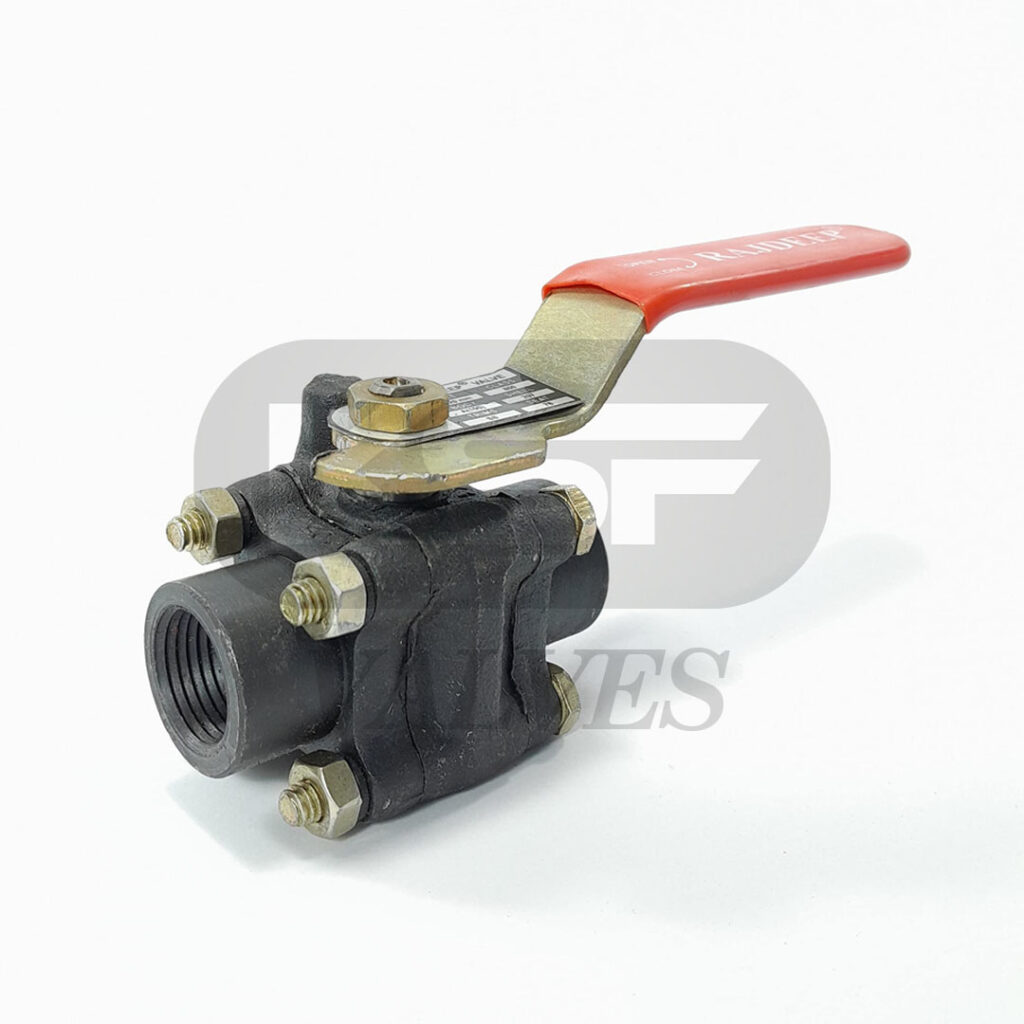
Forged Ball Valves
Forged ball valves are heavy-duty valves made from forged steel for superior strength and durability. They use a solid ball to control flow, providing tight sealing and reliable shutoff even under high pressure and temperature. Compact in design and resistant to corrosion and wear, forged ball valves are ideal for steam, chemical, and process applications requiring robust performance and long service life.
Design and Construction:
• Forged ball valves feature a spherical ball with a through-hole (port) that rotates within the valve body to control the flow of fluid. When the ball’s port is aligned with the flow direction, the valve is open, allowing fluid to pass through.
• When the ball is rotated 90 degrees, the port is perpendicular to the flow direction, and the valve is closed, preventing flow. Forged ball valves can have either a full port or reduced port design, depending on the size of the ball opening.
• Forged ball valves are constructed using forged materials, which are produced by applying high pressure and temperature to shape metal into desired forms.
• The main components of forged ball valves typically include a body, ball (closure element), stem, seat, and end connections. The forged construction provides superior mechanical properties compared to cast valves, making them suitable for demanding applications.
Materials of Construction:
• Forged ball valves are available in a wide range of materials, including carbon steel, stainless steel, alloy steel, and other exotic alloys.
• The choice of material depends on factors such as the fluid being handled, temperature, pressure, corrosion resistance requirements, and compatibility with other system components.
Standards and Certifications:
• Forged ball valves are manufactured in accordance with industry standards and specifications such as API (American Petroleum Institute), ASME (American Society of Mechanical Engineers), ASTM (American Society for Testing and Materials), ANSI (American National Standards Institute), and others.
• They may also meet specific regulatory requirements or certifications for use in critical applications or hazardous environments.

KSF Valves Pvt. Ltd.
Floating Ball Valves
Floating ball valves feature a ball that is held in place by two seats but not fixed to the stem, allowing it to move slightly under pressure to ensure a tight seal. This design provides excellent shutoff performance and is ideal for medium-pressure applications. Compact, reliable, and easy to operate, floating ball valves are commonly used in water, chemical, and general industrial systems.
Design and Construction:
Floating ball valves consist of a ball with a through-hole (port) that is not fixed to the valve body but is instead free to move within the valve cavity.
The upstream seat provides additional sealing when the valve is in the closed position. When the valve is open, the fluid pressure pushes the ball against the downstream seat, allowing flow through the port.
The ball is held in place by the downstream seat, which creates a seal against the ball when the valve is closed.
Materials of Construction:
Floating ball valves are available in a variety of materials to suit different application requirements, including carbon steel, stainless steel, alloy steel, and other exotic alloys.
The choice of material depends on factors such as the fluid being handled, temperature, pressure, corrosion resistance requirements, and compatibility with other system components.
Standards and Certifications:
Floating ball valves are manufactured in accordance with industry standards and specifications such as API (American Petroleum Institute), ASME (American Society of Mechanical Engineers), ASTM (American Society for Testing and Materials), ANSI (American National Standards Institute), and others.
They may also meet specific regulatory requirements or certifications for use in critical applications or hazardous environments.
KSF Valves Pvt. Ltd.
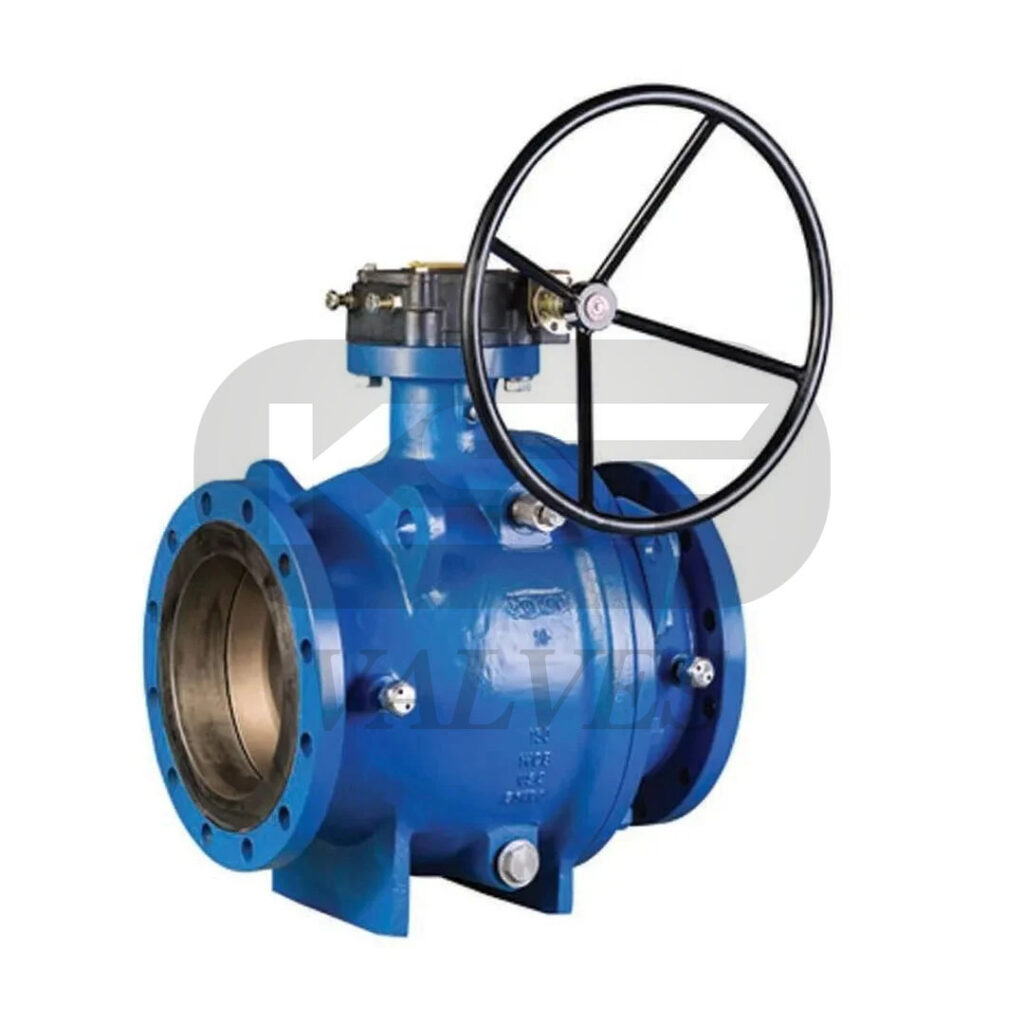
Trunnion Mounted Ball Valves
Trunnion mounted ball valves have a fixed ball supported by trunnions, reducing seat load and ensuring smooth operation under high pressure. They offer tight sealing, low torque, and high durability, making them ideal for large pipelines and demanding industrial applications.
Design and Construction:
Trunnion mounted ball valves consist of a ball with a through-hole (port) that is supported by trunnions (fixed shafts) at the top and bottom of the ball.
These trunnions are mounted within the valve body and provide additional support and stability for the ball, particularly in larger valve sizes and high-pressure applications.
The ball is held in place by the valve seats, which create a seal against the ball when the valve is closed.
Applications:
Trunnion mounted ball valves are used in various applications where reliable flow control and shutoff are required, particularly in medium to high-pressure environments.
hey are commonly installed in pipelines, process equipment, steam lines, and other fluid handling systems across industries such as oil and gas, petrochemical, power generation, refining, and chemical processing.
Standards and Certifications:
Trunnion mounted ball valves are manufactured in accordance with industry standards and specifications such as API (American Petroleum Institute), ASME (American Society of Mechanical Engineers), ASTM (American Society for Testing and Materials), ANSI (American National Standards Institute), and others.
They may also meet specific regulatory requirements or certifications for use in critical applications or hazardous environments.
KSF Valves Pvt. Ltd.
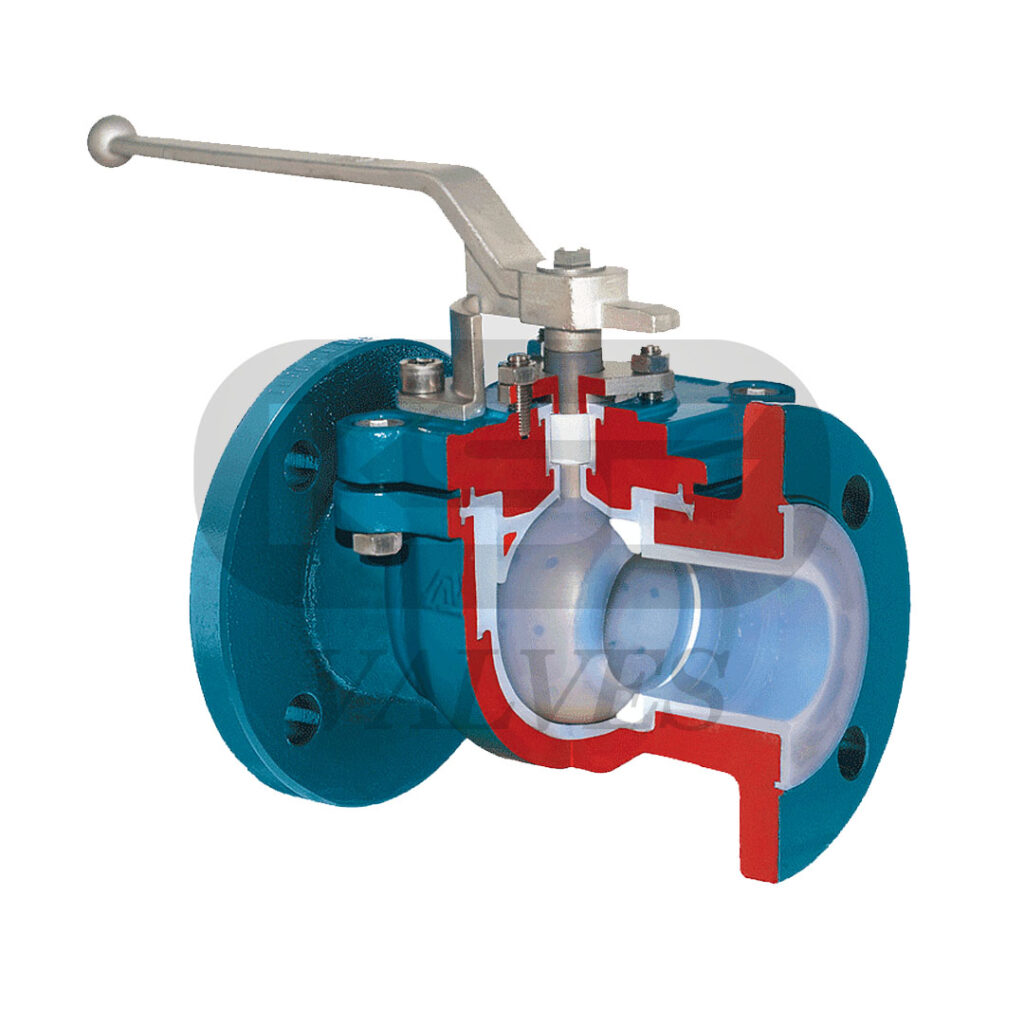
Lined Ball Valves
Lined ball valves have an internal lining, typically made of PTFE or other corrosion-resistant materials, to protect the valve body from aggressive chemicals. They provide excellent sealing, smooth flow, and long service life even in corrosive or abrasive media. These valves are ideal for chemical, pharmaceutical, and wastewater applications.
Design and Construction:
Lined ball valves operate similarly to standard ball valves, with the ball rotating within the valve body to control the flow of fluid. When the ball’s port is aligned with the flow direction, the valve is open, allowing fluid to pass through.
When the ball is rotated 90 degrees, the port is perpendicular to the flow direction, and the valve is closed, preventing flow. Lined ball valves can have either a full port or reduced port design, depending on the size of the ball opening.
Materials of Construction:
Lined ball valves consist of a ball with a through-hole (port) that is surrounded by a lining material, typically PTFE (polytetrafluoroethylene) or other fluoropolymer materials.
The lining covers the internal surfaces of the valve body, ball, and seats, providing corrosion resistance and preventing contact between the fluid and the valve body material.
The valve body and other components are usually made of materials such as carbon steel, stainless steel, or ductile iron.
Standards and Certifications:
Lined ball valves are manufactured in accordance with industry standards and specifications such as ASME B16.34, API 6D, ISO 17292, and others.
They may also meet specific regulatory requirements or certifications for use in critical applications or hazardous environments.